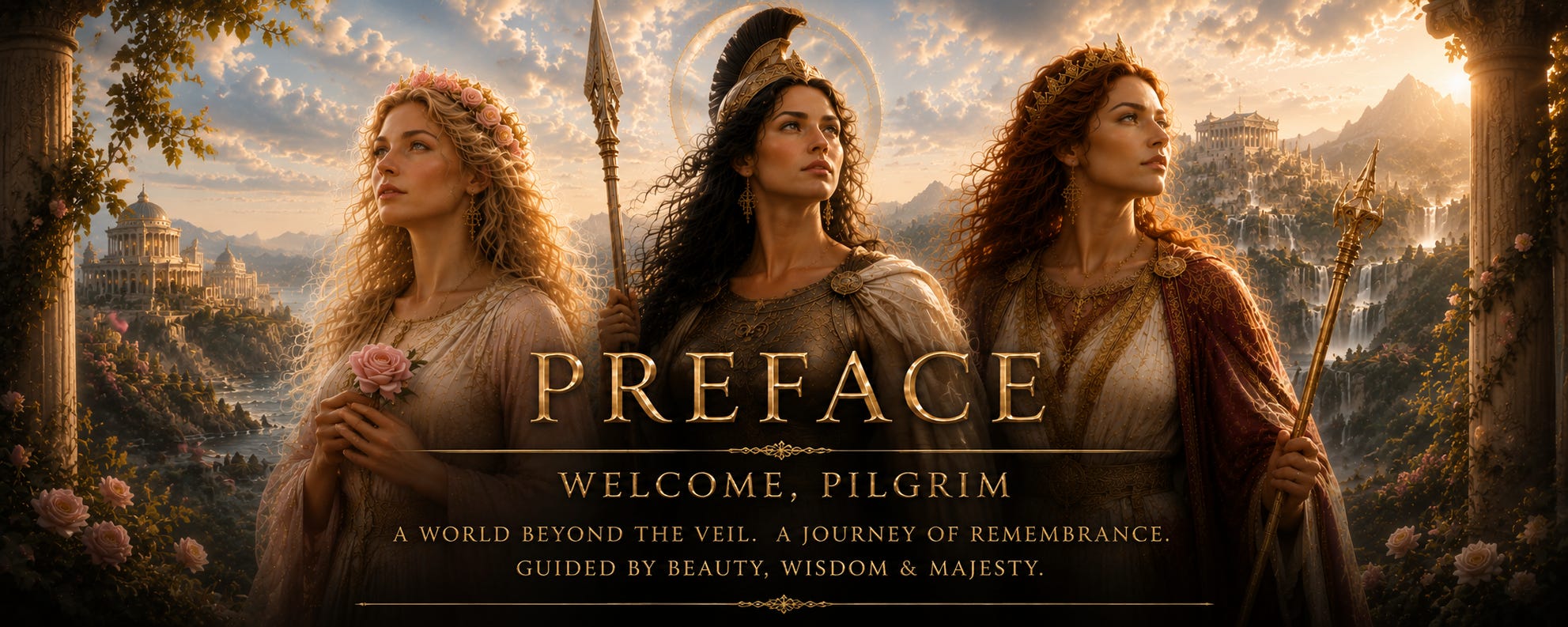
Welcome, pilgrim.
If you are holding this guide, you have likely already encountered the Sky-Veil in one form or another. Perhaps you first entered through the pages of Aphrodite’s Dance, followed the Wanderer across forgotten landscapes in Journey Across the Sky-Veil, listened to the voices of the Heralds in their teachings and reflections, or sat quietly beside Caelia and Mirelda in the stillness of the Thresholds. Whatever path brought you here, you have stepped into a world whose purpose extends beyond storytelling.
The Sky-Veil is not merely a collection of books, poems, hymns, reflections, and narratives. It is a unified mythopoetic vision. Across its many works runs a common thread: the conviction that the world is deeper, more luminous, and more meaningful than it often appears amid the distractions and anxieties of ordinary life. The Sky-Veil seeks to recover a sense of wonder before Being itself, inviting the reader to rediscover beauty, wisdom, majesty, remembrance, silence, and presence as living dimensions of human experience.
The stories unfold within a symbolic landscape known as the Sky-Veil. This realm is not presented as an alternative universe existing somewhere beyond the stars. Rather, it is a threshold—a shimmering middle-space where the visible and invisible meet, where longing begins to awaken, and where the soul gradually learns to recognize what it has forgotten. Within this landscape, rivers, forests, bridges, valleys, and distant highlands become symbols of the soul’s journey toward deeper participation in Being.
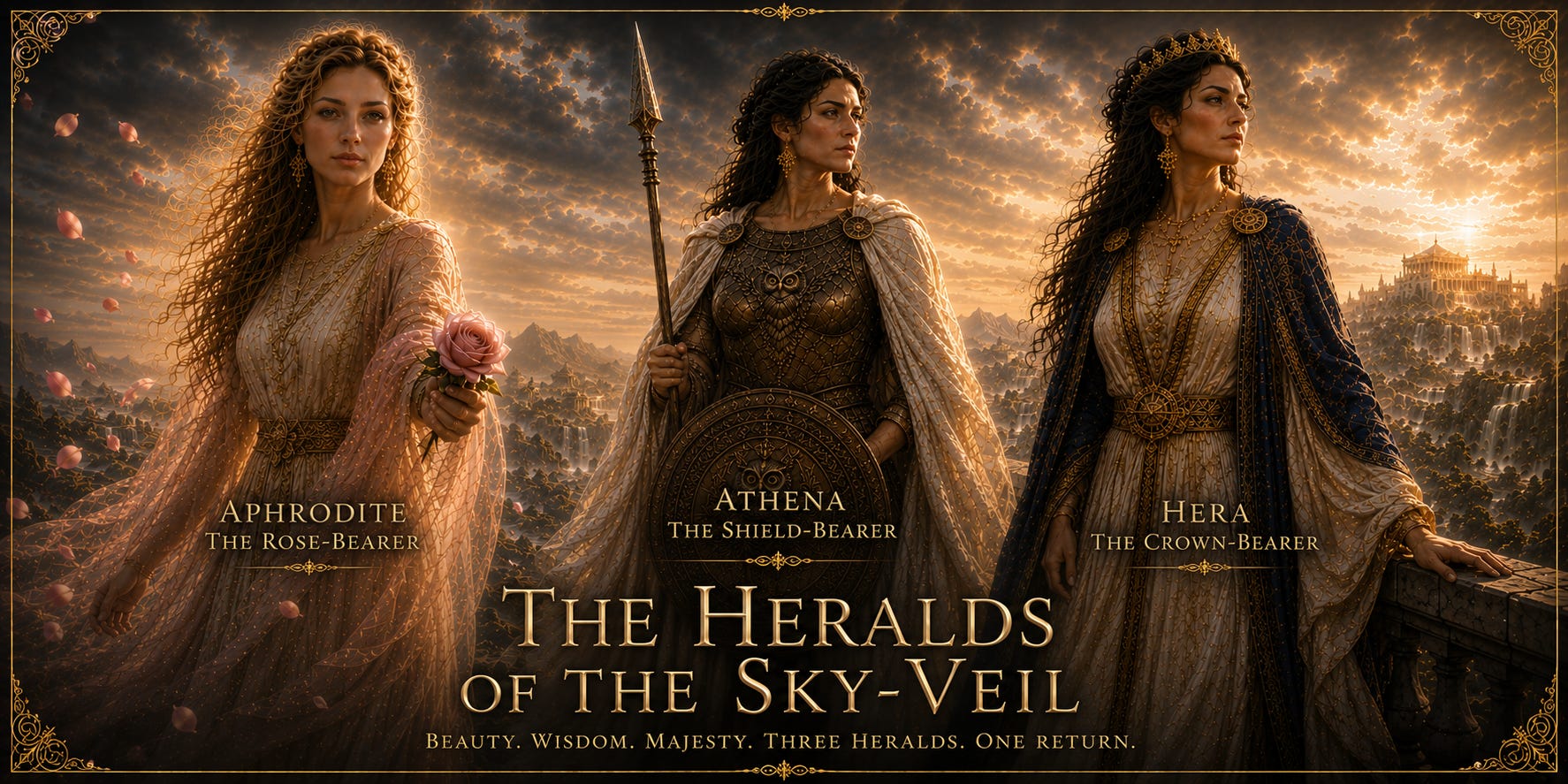
Guiding the pilgrim through these lands are the Heralds of the Sky-Veil. Aphrodite, Athena, and Hera stand at the heart of the original vision. Aphrodite awakens longing through beauty. Athena illumines the path through wisdom and courage. Hera reveals dignity, belonging, and the majesty hidden within every soul. They do not demand worship, nor do they seek allegiance. Their role is that of heralds. They announce, awaken, and point beyond themselves toward deeper realities.
As the Sky-Veil matured, new figures emerged from within its unfolding vision. Caelia, Bearer of the Silent Banner, and Mirelda, Keeper of the Chalice Beyond the Veil, opened new dimensions of contemplation. Through them the emphasis shifts from journey alone to dwelling, from seeking alone to receiving. Their appearance reveals that the pilgrimage is not merely about movement toward a destination, but about learning how to abide within the gifts already being given.
Beneath these narratives lies a deeper architecture. The Sky-Veil is concerned with remembrance rather than information, participation rather than observation, and presence rather than explanation. Its central concern is what later writings call Poetic Indwelling—the condition in which the pilgrim ceases merely to read the story and instead begins to inhabit it. Beauty shapes perception. Wisdom guides action. Majesty orders silence. The world itself becomes a place of encounter.
This guide was written to accompany that process. It is intended neither as a scholarly commentary nor as a definitive interpretation. Rather, it serves as a companion for readers who wish to understand the architecture of the Sky-Veil, the symbolism of its landscapes, the significance of its Heralds, and the deeper themes that unite its many works. Some chapters will explain. Others will orient. Still others will invite reflection. Together they form a map for pilgrims seeking to move more deeply into the world beyond the Veil.
Walk slowly through these pages. The Sky-Veil has always revealed itself gradually. Its truths are rarely shouted. More often they arrive as beauty, silence, longing, remembrance, or a sudden moment when the world appears radiant in a way it did not moments before. Such moments are easily overlooked. Yet they are often where the journey begins.
May this guide help you recognize them when they come.